Showing posts sorted by relevance for query "live art". Sort by date Show all posts

Monday, August 11, 2008

Finger Lakes Fantasia

As I mentioned last week, K (the girlfriend) and I took a little road trip in celebration of her birthday. We took off to the Finger Lakes region of New York, where K's friends J and W live, along with her de facto niece, V.

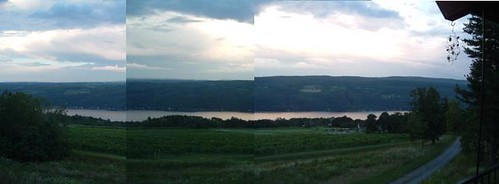
J & W live on the mountain rising from the eastern shore of Keuka Lake, above the village of Hammondsport. As you might expect, they have a magnificent view off their front porch:


Excuse the poor patch job - that's an attempt to string together three pix in panorama fashion. You get the gist, at least.

K and I spent the first night in the area in nearby Corning, which is something like a small city. It's know as Crystal City because of its long connection with glass manufacturing. With that in mind, the next morning K and I headed off to the Corning Museum of Glass. Here's K, peaking out from behind an over sized version of the museum logo, to which I took an instant liking. I've finally figured out why - it's very similar to the stylized "Q" that IQ used in the booklet artwork for Subterranea!


In addition to housing a huge collection of glass art and exhibits on the history and making of glass, the museum has a hands on bit where you, the patron, can make your own bit of glass art. K took advantage of the opportunity to make a glass bead (which she'll incorporate into some jewelry project down the road).

So the studio was our first stop, where K picked out the three colored glass rods that would get melt into shape:


K (with an assist from her Austrian assistant/summer wage slave) flaming away at the base glass bit:


And here we have said glass bit, before it cooled down any at all. Unfortunately, I wasn't quick enough to get a picture of the finished product before it took a sand bath for cooling. When K gets it in the mail, maybe she'll take a picture for me (hint hint!).


After the above craftiness, we moved on to the objects de art at the museum. A few of the more interesting pieces . . .. A formal gown made entirely from glass:


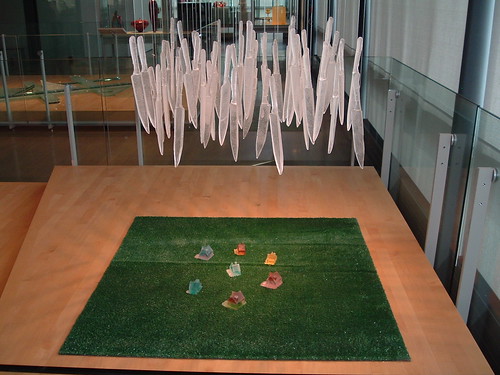
A large collection of glass knives, poised above an unsuspecting country town. I really like this one. I'm not sure what that says about me:


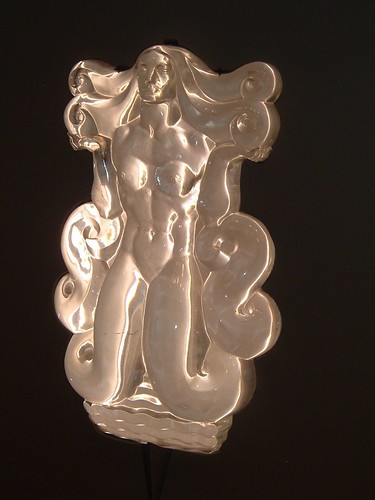
When K saw this one, she said it had to go on her wall. The least I could do was snap a picture.


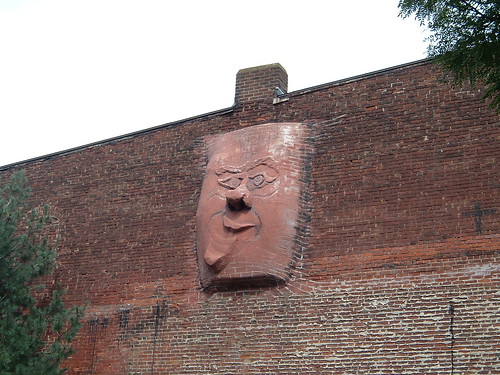
After we finished up at the museum, K and I met up with J & V and wandered around Corning's "gaffer* district," which includes a bunch of shops and restaurants. It also includes a couple of interesting pieces of building art. A gratuitous raspberry face on one building . . .


. . . and a buffalo bursting out of another. That's the Rockwell Museum of Western Art, so it at least goes with the theme. Note the artsy touch of me taking a picture of K taking a picture of the buffalo.


That was day one. Day two we took in a large dose of the region's other main industry - wine making. The shorts of both Keuka and Seneca Lakes are just riddled with vineyards. We decided to head up the eastern side of Seneca Lake and sample the local wares (K and I sampled, J drove, and V provided astute commentary). The ones that we hit, that I can find online and remember were:

There was at least one more, but I can't find it online and we didn't buy anything there, so perhaps that doesn't count.

I'll admit that, while I enjoy a glass of wine now and then, I'm far from an expert. K and J (and even V, for crying out loud) would talk about each sample in the terms of the trade, while I simply fell back on a simple "like it / don't like it" duopoly. That being said, I appreciated a bit of honesty from one of the folks at Atwater when I admitted that fact. He explained that I was no different from anyone else and that all those medals they so proudly display are really just popularity contests that comes down to the same "like it / hate it" choice. Props to him.

At Chateau La Fayette Reneau, we went out on the back porch and J took this loverly picture of K and myself:


Oh, yeah, and we bought some wine:


If you're playing at home, there's (from L-R) Catherine Valley's Seneca Steamer; Penguin Bay's Valvin Muscat and Percussion (x2); Chateau La Fayette Reneau's Seyval Chardonnay and Curvee Rouge; Red Newt's Red Newt White, Red Eft, and Gewurztraminer; Atwater's Meritage; Chateau La Fayette Reneau's Pinot Noir Blanc (pink wine for my sisters in law); Rasta's Sweet Forgiveness; and McGreggor's Sunflower White (a gift from J&W for K's BDay).

Day three we kicked around "downtown" Hammondsport before heading back to K's place. All in all a nice restful getaway. If you really need to see more pictures, they're here.

* Like you, I once wondered, "what the fuck's a gaffer? Contrary to what these guys say, it's not someone who gaffs. It's the highest rung on the ladder of glass workers.

Thursday, April 16, 2009

Album of the Day

Three Flew Over the Cuckoo's Nest, by Bela Fleck and the Flecktones (1993): For a brief period of time, Bela and crew were a three man operation, after keyboardist/harpist Howard Levy left and before wind man Jeff Coppin came aboard. This is the only studio album produced by that lineup and it's my favorite of Bela's studio albums (Live Art is in a league of its own). Pared to three players, all of them deployed an impressive array of tech toys to fill out the sound. The result never sounds forced or fake and it was all played live in the studio, according to the liner notes. Bruce Hornsby and Branford Marsalis make appearances on a couple of tracks to flesh things out.

Thursday, December 28, 2006

2006 - My Year in Tunes

As promised (or perhaps threatened, depending on your point of view), here is my annual collection of musical reflections on the year past. Keep in mind that I don't contend that these are the "best" of anything, but I suppose it's fair to say they are my favorites from the last 12 months. As usual, they're divided into 2006 tunes and pre-2006 releases.

New for 2006

  • Univers Zero - Live: When I first experienced Univers Zero (via The Hard Quest), I was a little perplexed. It was a little sterile, not very "rockish," and not nearly as dark as I thought it might be. Nonetheless, I took a chance on this new live album when I came across it and I'm very glad I did. Maybe it's the more aggressive bass playing, but the material in this set smokes. The THQ tunes are sharper and livelier and the other stuff ("Toujours Plus A L'Est", in particular) are equally good.
  • Mike Keneally Band - Guitar Therapy Live: What would one of these annual recaps be without some Keneally? It'd be easier to leave him off it he'd do something not worth talking about. Alas, this smoking live disc isn't it. It documents the second tour of the MKB in four-person form, with Mike joined by bassist Bryan Beller, and guitarist Rick Musallam joined by Zappa vaultmeister Joe Travers. Mike admits in the liner notes that he pretty much flung restraint to the winds on this tour, but the results are almost always justified and, at times, sublime. The version of "Hum" on this disc is worth the price of admission alone.
  • The Tangent - A Place in the Queue: This album, The Tangent's third, is also the band's longest and, as a whole, it suffers for that. Some judicious editing would help, but when the band is cranking on all cylinders, it's the best symphonic prog of the year. Composer/keyboardist Andy Tillison takes over all vocal duties with the departure of Roine Stolt and shines on the first two tracks in particular. "In Earnest" deals with a forgotten WWII pilot whose life since has been a disappointment and is alternately rocking and thoughtful. "Lost In London" tells the story of Tillison's mid-80s journey from his country home to London in search of a record deal and how "Yorkshire folk," and by extension all of us outside the cathedrals of power, are ignored by the higher ups. Seriously good stuff.
New to Me in 2006
  • Brian Eno - Another Green World (1975): Although I was vaguely familiar with Eno's reputation, I hadn't heard any of his work before finding this a used copy of this album. My curiosity was piqued by the roster of musical accomplices (Phil Collins, Percy Jones, Robert Fripp) and well wishers (Fred Frith, Ian MacDonald, Pete Townsend, Robert Wyatt). I was pleasantly surprised by the material, a collection of early eletronica-flavored art pop.
  • Frogg Cafe - Fortunate Observer of Time (2005): Frogg Cafe began life as a Zappa tribute band, but has evolved into an original musical entity of its own with a unique style. Yes, there are Zappa influences (particularly in the instrumentation - tuned percussion, trombone, etc.), but the band draws from a wide array of jazz, fusion, and prog influences. This was one of my favorite finds of the year, once I got past the rather abrupt opening to the disc (it just seems rushed for some reason)
  • Sigur Ros - () (2002): Somewhat like Eno, I was a aware of Sigur Ros for a while, but never actually heard them. Thanks to a birthday present from the girlfriend (thanks, honey!), I've been exposed and probably infected. This is some hard stuff to get your head around (not driving music, that's for sure), but very rewarding. It reminds me of a mix of Godspeed You Black Emperor! (or however they're punctuating themselves these days) and Kid A-era Radiohead, right down to the vocals - the lead singer's voice sounds like Thom Yorke and since I can't understand half of what Thom says anyway, the made-up language in which these tunes are sung doesn't bug me.
  • Beardfish - The Sane Day (2005): Another gift (this time Xmas - thanks, Mom & Dad!), this two-disc concept album has been in heavy heavy rotation this week. More Zappa influences, but this time amalgamating more rock and symphonic influences than Frogg Cafe. The story itself is about a guy who returns to his hometown after getting dumped by his girlfriend, only to find that things have gotten weird back home (among the characters he meets is "a filthy motherfucker by the name of Dwight" who learns to attract women via some kind of punk ballroom dancing). Lots of instrumental breaks thrown in for good measure. I can see why these guys were the big hit at ProgDay this year.
So, there you have it. On to film!

Wednesday, April 27, 2005

Album of the Day

Live Art, by Bela Fleck & the Flecktones (1996): I haven't had one of those "must have" albums as an AotD lately, but this one certainly is. Two discs chocked full of live performances from Bela and company, augmented by a host of talented folks (Chick Corea, Bruce Hornsby, Edger Meyer, etc.). This would be a very good introduction to the 'Tones, as it takes a few cuts from the studio albums and mixes them in with otherwise unreleased stuff. My favorites are the Scottish-flavored reggae of "Lochs of Dread," the folk-song based "Far East Medley" (including a tune I played in the high school band), and bassist Vic Wooten's solo on "Amazing Grace." But, hell, it's all good - just go get it now!

Monday, March 01, 2004

Album of the Day

Bela Fleck and the Flecktones: Live Art. This is a different sort of live album, as more than half of the material was new when it came out. Culled from many different performances, it focuses on the trio version of the 'Tones, augmented by numerous guests, from original 'Tone Howard Levy to such diverse as Chick Corea, Branford Marsalis, Bruce Hornsby, Sam Bush, and Edgar Meyer. The band is tight and hits lots of different highlights. Each of the main 'Tones gets a solo spot, including Vic Wooten's magical version of "Amazing Grace." If you own only one Flecktone album, make it this one.

Wednesday, July 08, 2009

The Perils of Totalitarian Art

I've always been attracted to movies with interesting back stories. While Brazil is now one of my favorite flicks, I was initially attracted to it because of the titanic struggle that Terry Gilliam had to go through to get it released as he wanted it in the United States.

Along those same lines, I'd always wanted to see Alexander Nevsky, Sergei Eisenstein's tale of a 13th-century Russian hero's triumph over invading German crusaders. Finally, thanks to a well timed Borders coupon, I've been able to get my hands on the Criterion Collection version (which comes boxed with Eisenstein's two part Ivan the Terrible). If nothing else, it is a potent example of how a repressive dictatorship shapes art, in both overt and subtle ways.

Nevsky was the product of two brilliant artists in desperate need of a "hit," so to speak.

Eisenstein made his name as a pioneer of Russian silent film, most notably for The Battleship Potemkin. But by the time Nevsky was made in 1937, however, he was outside of the Soviet artistic power structure. A few years in Hollywood hadn't been fruitful. On return to the Soviet Union, Eisenstein had production on his film Bezhin Meadow (what's left of it is a bonus feature on the Criterion DVD) shut down by the government for being politically incorrect.

Eisenstein's collaborator was in similar straights. Composer Sergei Prokofiev had also gone abroad, though with more success. When he returned to the Soviet Union in 1935, he found himself working under the watchful eyes (and ears) of the "Composers' Union," which sought to limit outside influence in Soviet music. One of his works, Cantata for the Twentieth Anniversary of the October Revolution, was banned and went unheard until 1966.

With that background, you can see why Eisenstein was desperate. As this lengthy and funny review explains:

So when it came time to write his next screenplay, Eisenstein collaborated with Pyotr Pavlenko, a member of the secret police who allegedly sat in on NKVD interrogations. American filmmakers bitch and moan about dealing with Philistine studio executives, but at least those guys only pretend to be bloodthirsty madmen. To say Eisenstein was operating from a position of limited power is an understatement. It's not a surprise, then, that Alexander Nevsky is unsubtle and clumsy in its ideology. The real wonder is it wasn't titled Please Don't Kill Me, Comrade Stalin.
Eisenstein chose Nevsky as a subject partly because so little was known about him and thus there was less chance of ideological straying. Eisenstein wound up making a film that's not just shot in black and white but is black and white in its storytelling: the honest (and oddly irreligious, for the 13th century) Russians, led by their humble superman of a leader (that would be Nevsky), defeat the invading very Catholic and nearly mustache twiddling German horde in a spectacular battle on a frozen lake. The script almost writes itself.

That background alone would be sufficient to make Alexander Nevsky a paradigmatic example of totalitarian art. But the regime impacted the film in a more subtle, and perhaps unintended, way.

Einstein and Prokofiev were truly collaborators on the project. According to another of the bonus features on the Criterion DVD, parts of the score were actually written first. Eisenstein would then take the music then shoot and cut the visuals to match. It was a technique inspired by, of all things, Disney's Silly Symphonies and, a project in the works while Eisenstein was in Hollywood, Fantasia. The result should have been a seamless marriage of visuals and music, something along the lines of what Stanley Kubrick would achieve decades later in 2001.

Instead, the regime trod all over the soundtrack in two critical ways. First, authorities required that Prokofiev record the score in a Soviet studio using Soviet equipment. Problem was, Soviet studio technology was about 15 years behind Hollywood's, which meant that the score wasn't very well recorded to begin with. Second, Stalin became so infatuated with the film that he rushed it into theaters before the soundtrack was polished. The speculation on the Criterion bonus feature is that the score we have now was meant as a "scratch" or demo track, which Prokofiev never had the chance to redo. Not surprisingly, the film is sometimes shown today with a live orchestra playing the score.

Audio quality problems aside, catching Stalin's favor must have been good for business, right? Oh it was, for a bit. The film opened in November 1938 to popular acclaim, before the tide of history swamped over it. On August 24, 1939, the Soviet Union signed a nonaggression pact with Nazi Germany. As I mentioned above, the movie is about a Russian army turning back invading Germans. That wasn't a politically astute story to tell once the nonaggression pact was signed, so the film was withdrawn from circulation.

If you know your history, you can probably figure out what happened next in the life of Alexander Nevsky. On June 22, 1941, the Nazis broke the nonaggression pact and invaded the Soviet Union. Hey, what a great time to push a film about brave Russians turning back German aggressors back into theaters! Ever since, the film has been part of the lore of Soviet cinema and remains the most popular (if not most acclaimed) work of Eisenstein's career. Prokofiev took the music for the film and repurposed it into the Alexander Nevsky Cantata, which remains a popular work today.

All that being said, how does Alexander Nevsky work as a flim? Honestly, it was a bit of a disappointment. Granted, it's more than 70 years old, but a lot of it comes across as stiff, sometimes bordering on corny (I agree with a lot of what's said in the review I quoted above). The good guys are really good and the bad guys are really really bad (they make the Borg or the Daleks look charming by comparison). That being said, it has some stunning visual sequences and the music is wonderful.

If you can lay your hands on a decent version, I highly recommend it. Not so much as brilliant cinema, but as a historical example of the kind of art that gets produced when the state tries to micromanage its artists. Sometimes, the better story is behind the camera, rather than what happens in front of it.

Monday, October 13, 2008

Perfect Albums?

It's a holiday Monday, so what better time to indulge in some pointless list making? In this case, the impetus is this post over at Concurring Opinions, in which Deven lays out his "perfect" albums.

On a fundamental level, I quibble with examples of "perfect" anything - humanity is a flawed enterprise, even at its best, and nothing we make can really be "perfect." But on a more practical and more fun level, here's the albums in my collection that have obtained the fabled "10 of 10" rating in my inventory program, which is close enough (as they say) for rock and roll:

  • Dave Brubeck - Time Out
  • echolyn - Suffocating the Bloom and mei
  • Bela Fleck and the Flecktones - Live Art
  • Genesis - Selling England by the Pound and Seconds Out
  • Gentle Giant - Octopus
  • Kevin Gilbert - The Shaming of the True
  • Bruce Horsnby - Harbor Lights
  • Mike Keneally & Beer for Dolphins - Dancing
  • King Crimson - Discipline
  • Marillion - Brave
  • National Health - Of Queues and Cures
  • Premiata Forneria Marconi - Storia di un Minuto
  • Ritual - The Hemulic Voluntary Band
  • Paul Simon - Graceland
  • Sting - Bring on the Night
  • Yes - Close to the Edge
There are lots of greats that come up just short, with 9s (55 of them to be exact), that might make the list if I really wanted to think about it.

So what are your "perfect" albums?

Thursday, February 28, 2008

Album of the Day

Live Art, by Bela Fleck and the Flecktones (1996): Two things. First, yes, this is out of order when compared to yesterday's AotD - that's what happens when a snow day throws you for a loop. Second, I know I seem to gush about this album just about every year, but it really is that good.

Wednesday, March 01, 2006

Album of the Day

Live Art, by Bela Fleck and the Flecktones (1996): I'm fairly sure that I rave about this album every year, so I won't go on at length this time. Suffice to say that across these two discs is enough brilliant musicianship that if you've never even heard of Bela and his pals, you should go right out and buy this right now!

Wednesday, February 07, 2007

Album of the Day

Bring on the Night, by Sting (1986): Last week I was praising artistic risk taking, and Sting's post-Police solo project certainly involved risks. Before he slid slowly into adult contemporary malaise, he put together a band of young jazz guys and produced some of the best art-pop/jazz outside of Steely Dan. The studio album that resulted, Dream of the Blue Turtles, is good, but this -disc live set is outstanding. The new tunes work better live than on record and the old Police tunes, reworked to fit the skills of Marsalis, Jones, Hakim, and Kirkland, are great.

Tuesday, November 10, 2009

On Annoyance and Art

When it comes to fictional characters, main characters at least, most audiences want them to be likable. They want to empathize with the hero battling evil or the underdog overcoming huge odds. At the very least, we don't want the main character to be an annoying dipshit.

Not that annoying dipshits can't be entertaining. John Cleese has made a living annoying other people for a living. He even made an instructional video, How To Annoy People, along the way. Of course, that's in laugh out loud farcical situations.

And we love annoying dipshits who get their comeuppance. Think of the title character of Voltaire's (and later Bernstein's) Candide, who is indoctrinated in the worldview that this is the best of all possible worlds. It takes scrapes with the Lisbon earthquake, and auto-de-fe, and other horrors to shake his perception. But at least he comes around in the end.

But what about a character who starts out annoying, stays that way throughout the picture, and doesn't have a change of heart in the end? If the idea intrigues you, may I recommend Mike Leigh's film Happy-Go-Lucky. It'll mess with your mind.

Happy-Go-Lucky is the story of Poppy, a 30 year old with the sunny disposition of a pre-angst tween. She is precisely the kind of person that would annoy the hell out of me in real life. Relentelessly positive, quick to toss off of non-sequitor to answer a question, and never (well, almost) thrown off stride by what life throws at her, whether it be a bicycle thief, a racist conspiracy theorist driving instructor, or a babbling homeless man. She seems impervious to the real world and all the troubling things that go with it.

So I hated the movie, right? Poppy never learns her lesson, never straightens up and starts to act like the adult she is. What could be more aggravating, right?

Except it isn't. As the film progresses, we see that Poppy is actually a very admirable character. She has deep connections with those around her, from her roommate of a decade to her family and coworkers. She has a job, an important one, that she does well. Her coworkers seem to respect her, at least. Rather than being oblivious to the shitty bits of the world around her, she just refuses to let then ruin her good mood. She's actually kind of impressive, in her own way.

The bottom line is this - Mike Leigh took a character who is clearly annoying and managed to make me admire her. I still didn't care for her, in the end, but I had sufficient respect for her to let her live her life on her own terms. If nothing else, that's a hell of an artistic accomplishment, but what else would you expect from Leigh?

After all, her way of dealing with the world didn't harm anybody else, so what the fuck? I'll just cross the street if I see her bopping down the sidewalk.

Thursday, October 01, 2009

Call Me Old Fashioned

Although I like to think of myself as a technologically hip and cutting edge kind of guy, I admit that when it comes to media I'm a bit of a stick in the mud (as the comments to this post pointed out!). I like my music on CDs, something tangible I can hold in my hand, rather than just as files on a PC or iPod. Similarly, I like my books (although CDs outnumber books in my house) the same way, except for the occasional audiobook (so sue me - I'm in the car a lot).

I bring all this up because today's New York Times has a story about the next big thing in "books" - video:

On Thursday, for instance, Simon & Schuster, the publisher of Ernest Hemingway and Stephen King, is working with a multimedia partner to release four 'vooks,' which intersperse videos throughout electronic text that can be read — and viewed — online or on an iPhone or iPod Touch.

And in early September Anthony E. Zuiker, creator of the television series 'CSI,' released 'Level 26: Dark Origins,' a novel — published on paper, as an e-book and in an audio version — in which readers are invited to log on to a Web site to watch brief videos that flesh out the plot.
In the short attention span age in which we live, publishers see this as a way to hook readers who wouldn't normally take the time to get tied down to a real book.

I don't actually have any objection to using new media as part of story telling, but it's really not a book, is it? I mean, unless you're reading it (or having it read to you), it's something else. In a similar fashion, a performance by people on a stage with dialog, action, etc. is a play. Putting the same thing on film turns it into a completely different piece of art (a fact that many directors adapting plays for TV or film don't grasp).

Maybes it's the wave of the future. Honest to goodness books will wither and die, to be replaced by some sort of multimedia experience, that stimulates all our senses instead of just our imagination. I hope it doesn't go that far, though. There's something about the written word that exercises your brain. As author Walter Mosley puts it:
Reading is one of the few experiences we have outside of relationships in which our cognitive abilities grow
As a species, we don't want to lose that, do we?

Hey, wait a second . . . that gives me an idea for a novel!

Thursday, December 28, 2006

2006 - My Year in Film & Video

As in prior years, by Netflix addiction continued unabated. Going back through my rental history, it was actually fairly difficult to narrow it down to a few flicks that really stood out. Again, not "best," but favorites (at least some of them).

  • The Prestige (2006): Hey, something I actually saw in the theater! This tale of feuding magicians in 19th-century London was fun just to sit back and enjoy. Maybe not the deepest thing in the world, but the constant one-upmanship between the two main characters is a lot of fun (in a very self destructive way!).
  • Clerks II (2006): As a big Kevin Smith fan, I was a little apprehensive about a sequel to Clerks. Was Smith just looking for a safe haven after the debacle of Jersey Girl and running back to familiar material? Yeah, probably. In the end, did it matter? Nope. While not the classic that the original is, Clerks II had some tremendously funny bits and something vaguely resembling a plot that satisfied.
  • V for Vendetta (2006): Hype for this flick convinced me to go out and get the graphic novel of the same name, by first real exposure to the genre. The movie can't really hold a candle to the book, but was pretty cool on its own merits. But the book got me hooked on graphic novels, anyway.
  • Paradise Now (2005): If V for Vendetta was about a terrorist who was sure in his motives and means, Paradise Now is about just the opposite. The first Best Foreign Language Film Oscar nominee from the Palestinians, this film follows two friends who are called upon to fulfill their pledge to become suicide bombers as part of the Intifada. This is not a story that tries to "justify" the taking of human life - it is about the mental process that might go on inside someone who is so sure of their path in life, and one who is not so sure.
  • The Saddest Music in the World (2003): Flat out, this is one of the strangest movies I've ever seen. It tells the story of a Canadian brewery baroness who launches a competition during the Depression to find out which country has the saddest music in the world. Competitors arrive in Winnipeg (IIRC) for a series of 1-on-1 matchups, after which the winner splashes down into a pool of beer. There's a layer of melodrama and flim-school "art" on top of the story that requires a little bit of patience to get used to. Once you do, however, it's a really neat flick (great leading man turn by former Kid in the Hall Mark McKinney).
  • Ikiru (1952): A Kurosawa classic in which a lifelong bureaucrat learns he has terminal cancer and decides to "live life." Except that he discovers that the traditional ways of living the high life (women, wine, song, etc.) are as hollow as his prior paper pushing days. He finds meaning in actually navigating a needed public works project from need to completion before his death. In an abrupt shift of point of view, the film goes on for another 45 minutes after the main character's death, as his mourners argue about the meaning of what went on before. A brilliant piece of film.
  • Fire (1996), Earth (1998), Water (2005): The girlfriend is a fan of foreign films, especially those from Southeast Asia and India. Thanks to her, I experienced this trilogy of Deepa Mehta flims in the space of a few weeks. Each deals with controversial issues in modern India, including the Indian/Pakistani partition (Earth), lesbianism among Hindus (Fire), and the treatment of impoverished widows (Water). Fire and Water both led to violence during the production and release of the films in India. All are excellent, but I think Water is the best.
Wow, it was quite a year. That's it for the Ranch, 2006 edition. See everybody in the new year, after another WVU bowl victory!*

* Hey, it worked last year. :)

Friday, April 04, 2008

Album of the Day

Wooden Smoke, by Mike Keneally (2002): If there was ever an album that sounded like the album title and cover art, this is it. After a couple of "Beer for Dolphins" records, Mike went solo again for this largely acoustic effort. I always think of autumn and the first firing up of wood stoves when I listen to this album. There are only a few traditional songs on the album (such that they'd get played live), while most of the tracks float and meander along. That's not to say it's formless or pointless, just very laid back. And it contains one of my favorite Keneally tracks, "Dee 'N' A," with its twin acoustic guitar opening leading to a lengthy electric solo. Good stuff.

Friday, September 15, 2006

I Like The Onion, but . . .

I'm a regular devotee of The Onion and it's not-at-all made up cultural section, the A.V. Club. So I'm particularly distressed by today's Inventory selection, "10 Highly Pretentious Musical Instruments." First, I'm assuming they mean ". . . in Pop Music," since it would be hard to hammer too much on the flute and grand piano in the classical realm. Second, they take some pops at a progressive rock staple, the Chapman Stick:

Art rock—especially '80s-00s King Crimson—wouldn't be complete without the Chapman Stick, a combination guitar and bass that looks like a 2x4 and is played by tapping the strings with both hands. (Or with little drumsticks tied to your fingers, if you're Tony Levin.) Though its clean lines look best next to the stylishly bald and mustached Levin, it's forever connected to serious, ponytailed men like Trey Gunn, who look like they treat "picking" and "strumming" with a sniff of contempt. The Chapman Stick is also worn across the chest with the top resting on the player's shoulder, giving the impression that it's so precious, it needs to be cradled.
I guess I don't get "pretentious." The Stick, and its descendent the Warr Guitar, are innovative instruments that do something different than your traditional rock band staples. What's pretentious about that? Or should rock and pop stay in three chords and a cloud of dust territory? If doing something different is pretentious, then I guess I like pretentiousness. Of course, as I write this I'm watching Bela Fleck jam on stage playing jazz banjo along with guys playing steel drums, bassoon, and a sorta guitar looking drum machine - so what does that tell you?

And, for the record, the "little drumsticks tied to your fingers" aren't for the Stick. Funk fingers, as they're known, were developed by Levin so he could get the same percussive bass sound live during Peter Gabriel's "Big Time" as he did in the studio, when drummer Jerry Marotta actually pounded the strings with drumsticks.

But, still and all, they're right about one thing. Bagpipes suck ass.

*runs away after throwing that grenade in Scottish boy's direction*

Wednesday, October 26, 2005

But What About the Halftime Show?

I enjoy sporting events precisely because they are sporting events, not excuses for what passes for entertainment or art to have the world stage for a few fleeting minutes. They're generally awful, anyway, and can't even be saved by the stray flash of tit here and there. So I tend to pass on things like the Olympic opening and closing ceremonies and focus on the competition itself. Thankfully, the World Cup has avoided such silliness, until 2006. FIFA is staging a grand opening ceremony, to take place before the first match in Germany.

While that sounds like a waste to me, I'm at least intrigued by their choice of artist to run the show: Peter Gabriel. If anybody can do a lavish visual spectacle that actually has some interesting musical bits, it's Gabriel. Hell, it would make the perfect stage for the much talked about Genesis reunion, wouldn't it? But aside from that, I can think of several tunes Gabriel could work into the show: a slightly reworked "Here Comes the Flood (of Goals);" depending on how the minnows are predicted to do, either "Downside Up" or "Mercy Street;" if Freddy Adu makes it into the US squad by Germany, maybe "Growing Up," unless he's having a spat with Bruce Arena, in which case "Come Talk to Me" would be more appropriate. And, of course, the whole thing must end with all the referees lined up for a rousing version of "In Your Eyes."

The soundtrack for the post was provided by, you guessed it, PG's very cool Growing Up Live DVD!

Tuesday, March 23, 2004

Karma Will Hunt You Down

In what is either a case of bad timing or spectacularly bad karma, the band Great White just released a new album called Burning House of Love. Great White, of course, were on stage when a pyrotechnics malfunction sparked a fire that burned down a Rhode Island nightclub last year, killing 100 people - including the band's guitarist. The album is a re-release by an Italian label which, the band contends, does not have the permission to do so.

Still, it pales in comparison to the bad timing that greeted the release of prog-metalists Dream Theater's Live Scenes From New York. Part of the band's visual design for a long time had been a heart engulfed in flames. The cover art for this album had the flaming heart silhouetting several well known NYC landmarks, including the World Trade Center. It was released on September 11, 2001. You can see the cover here.

Tuesday, July 10, 2007

In Which I *gulp* Defend Pop Music

Anybody who reads this blog regularly, especially during the A-Z months, knows that I'm not a big fan of truly "popular" music - as in the stuff that dominates the radio, MTVs, and the 'Net. Having said that, I don't hold it in nearly the disrepute that the guy(s?) who runs this website does. His lengthy screed on the evils of pop music is filled with such bile, arrogance, and elitism that it borders on parody, at times. I found it, of all places, in this thread on the writer's forum on which I lurk.

Over the course of 36 single-spaced pages (I had to copy it into Word to make it legible - that's 1 inch margins all around and Garamond 12-point, if you're scoring at home), a few themes emerge: 1) complexity is good, simplicity is bad; 2) pop music - which appears to include everything that is part of the mass produced culture, including variants of rock - is much more simple than classical music; and 3) you'd have to be a slack-jawed amoeba of a human being to actually enjoy pop music. Along the way, he throws in quotes from various other pop haters and cultivates the image of an angry old man sitting on his front porch, pants hoisted up to his armpit, screaming about "those damn kids."

In fact, it reminds me of the "critic" from Zappa's "The Evil Prince":

I'll say its disgusting, atrocious, and dull
I'll say it makes boils inside of your skull
I'll say its the worst -of-the-worst of the year,
No wind down the plain, and its hard on your ear

I'll say its the work of an infantile mind
I'll say that its tasteless, and that you will find
A better excuse to spend money or time
At a Tupper-Ware Party, wee-oo
So, do be a smarty!
Oo-oo-wee-oo

Hold on to that dollar
A little while longer
For spending it here,
Why, it couldnt be wronger!
Let's begin, shall we?

The first whopper I found was the claim that:
Pop and rock is easy listening, easy watching, easy thinking.
Now, I don't disagree that a great deal of pop music - hell, any music - doesn't tax the ears. But there's plenty of classical music that's as interesting as hearing paint dry and has, in fact, become the background music of a lot of lives. I wouldn't paint Stravinsky's work with the same broad brush, however, which makes me wonder if the author has ever actually heard the edgier progressive rock, electronic, or techno stuff. Or metal. Fuck, Megadeath is "easy listening?" If he thinks "Larks Tongues in Aspic" is easy listening, he's got impossibly high standards.

Next up is an assault on the rhythm of rock:
The vast majority of the music is in 4/4 time. Thus, other time signatures, the common 3/4 and others such as 12/8, 5/4, 7/8, 6/8, 7/8, 7/16 etc. are not part of the vocabulary. Metre changes within a piece are not allowed, this is set at the beginning and never varies.
Again, he paints with too broad a brush - there's plenty of prog, art-rock/pop, fusion, etc. that deals with funky meters and time changes. Hell, Gabriel's first "hit," "Solsbury Hill" is in 7/4. There are countless others. But it also misses the point that vast swaths of the classical repertoire is in 4/4 or 3/4, often without sacrificing rhythmic complexity.

Another criticism:
The musical language is conservative and old fashioned. Despite its apparent and claimed modernity, pop and rock uses the musical tools and the musical language of the nineteenth century or even earlier . . ..
Fair enough, as far as it goes. Again, the same is largely true of modern "classical" music that has any kind of audience. The really weird stuff, the ground-breaking stuff, does not draw them in at most concert halls across the country.

It also sets the writer up for a supreme hypocrisy. After slamming pop/rock for its "old fashioned" roots, he later turns around and slams its attempts to break out of that mold, too. For example:
The Beatles are, in fact, an interesting case since it can be convincingly argued that what was distinctive about this group were the contributions of George Martin, a classically trained musician who nevertheless had to operate within the constrictions of the pop format. The work of the individual Beatles, without Martin, has been undistinguished. Even so, even with Martin, the band’s output was original only in so far as it used clichés from popular music other than pop and rock, such as music hall, nursery rhyme, and brass band music.
So not only is the genre stagnant and conservative, but when someone tries something different, it's probably not the rock/pop guy's idea, anyway. Besides, they steal from other forms (as if Dvorak, Stravinsky, Copland, et. al. didn't?). It goes even further, when we get to the sound of pop/rock:
Amplification is frequently considered an advantage in the pop and rock world because it enables distortion of sound patterns. However, the problem with electrified, amplified instruments is that subtlety of tone and detailed control of the sound one produces suffers to a considerable degree.
So, again, when pop/rock tries to break out of the ghetto into which the writer has confined it, it gets slapped down for the effort. Yes, amplification does cause one to lose some "subtlety of tone," but it also allows for a host of interesting sounds and textures that you can't get from acoustic instruments. It's perfectly OK not to enjoy those kinds of sounds (maybe - see below), but its at least a bit disingenuous to condemn the effort to be original.

This next argument I find particularly odd:
It is commonly claimed that pop and rock music prizes 'tone' and colour rather than virtuosity and mastery of an instrument, and this is contrasted with classical music where, it is claimed, the emphasis is on virtuosity and technique (the implication is that classical music is sterile and 'academic'). This argument is clearly an excuse for the lack of skill of pop and rock musicians.
Offhand, I can only think of one subset of the pop/rock 'verse - punk - that actually values instrumental ineptitude. Other subgenres may not require great technical dexterity (or value self expression over that dexterity), but I think it's a stretch to say the players don't care about their technique. As for the "lack of skill" argument, it gets boldly restated:
Where is the pop or rock musician, for example, who is capable of playing any classical concerto?
Well, without thinking about it too hard, I can come up with a few that could hold their own. Steve Hackett could certainly handle a classical guitar concerto, given his nylon string work. Keith Emerson has (or had, before the carpal tunnel took over) the chops to play most piano concertos. Should I even mention that both of these guys have written works for their instruments and orchestras? I suppose you could call Keneally's The Universe Will Provide a guitar concerto, but it involves amplification (even an electric piano - horror of horrors!) and probably doesn't count.

Turn that around, for a minute, tho' - how many concerto-level pieces have composers written for electric guitar, bass, Minimoog, etc.? It's hard to judge the skill level of players of those instruments if the gods of the classical world don't write stuff for them. Besides, could Yo Yo Ma play the Stick part to "Elephant Talk?" I doubt it. What does it prove? Just that's he's not a Stick player. It doesn't reflect on his overall musical talent.

One point the anonymous writer makes that would be valid if he didn't push it too far and dip it in a heavy syrup of condescension is:
The idea of deep and concentrated listening to music is becoming increasingly foreign to the mass of the population - indeed the typical pop or rock music consumer primarily uses music as a background or as a rhythmic accompaniment against which to “dance”, if poll evidence is to be believed.
Love the scare quotes on "dance," BTW (one suspects that anything beyond rigid ballroom dancing styles suffer the same fate as pop music in this guy's mind). Like I said, that's true as far as it goes. He fails to mention, of course, that it's much easier to produce that kind of "background" today than it was 150 years ago, when classical music ruled the earth. Back then, the only way to hear music was to make it yourself or go someplace to hear it. Either way, active listening was pretty much required. The flaw in using music as background, in any event, lies with the listener him/herself, rather than the product.

As I said, even that sustainable idea he pushes too far, anyway:
In contrast to pop, it is clear that to appreciate classical music properly you must give it your full attention, and you need some knowledge of musical form and structure. In common with most popular culture, the appreciation of pop and rock requires no tutelage or special sensibility, not even close attention because of the simplicity of its structure and materials.
In other words, you must be an above average human being to get anything out of classical music, where as the baser pop/rock stuff can be appreciated by the plebeians among us. By that logic, why should the masses even try it? But he's not elitist, no no no.

Finally, he goes completely off the rails, as he takes on cultural relativism:
A much simpler version of this argument is simply to assert that the individual in question enjoys popular music - as if I were arguing that enjoyment of pop music is not possible and as if the simple fact of liking something automatically means that it is worthwhile, meaningful, entirely benign, and positive.
While I tend to fall into that camp of people who think that all art - music, film, literature, whatever - is inherently personal and affects each person differently in a way that we label "like" and "dislike," I can see his argument. Until he goes all Godwin on us:
Let’s take some examples and see where this type of argument leads. Proposition: It is right to kill all handicapped children at birth. Answer: Well, that is just a matter of opinion. Proposition: Hitler did some bad things. Answer: That is just a matter of opinion, and it is quite right that people are allowed to have widely differing opinions about this. It’s just a matter of taste. Proposition: The government of the Central Republic of Monsilvania has greatly damaged the economy of the country. Answer: Well you would say that but it is really just a matter of opinion and political preference. All statistics are lies anyway. I don’t think the government has done anything wrong.
Wow. Usually when the Nazis come into the discussion it's because the other guy is on thin ice. You're not supposed to go there while arguing with yourself!

Regardless, I have too much real world evidence of differing musical tastes to buy into the idea that one type of music has more value than another based on some objective measure.

This will seem contradictory, but, for what it's worth, I don't necessarily take issue with the fact that loads of pop/rock music is, to use a technical term, crap. At least to my ears. As Sturgeon observed, 95% of everything is crap. 95% of pop music is crap. 95% of progressive rock is crap. 95% of what I write on this blog is crap. 95% of classical music is crap. Identifying the non-crap is the difficult and very personal part.

Finally, also, for what it's worth, the site's main goal - cutting down on the amount of piped in music in public places - is laudable. The constant din that sometimes accompanies public life is seriously distracting. Besides, if a space needs musical accompaniment, why not hire some real live musicians to provide it?