40 years ago yesterday, man landed on the moon. It is, perhaps, the crowning engineering achievement of civilization (at least it would have won you the game Civilization). Conspiracy theories that the whole thing was a hoax are almost as old. Sadly, it seems that they've even wormed their way onto daytime TV, on the anniversary of the real thing, no less.
Let's just hope, for Whoopi's sake, she doesn't indulge in such nonsense around Buzz Aldrin:
'cause he's having none of it! Good for him.
Tuesday, July 21, 2009
What a Way to Celebrate

Friday, July 17, 2009
Album of the Day (Special Edition)
Number Seven, by Phideaux (2009): LA-based collective Phideaux, led by the namesake composer/vocalist/pianist/guitarist Phideaux Xavier, sort of broke through in the prog scene with their 2007 release Doomsday Afternoon. The second part of a trilogy about an ecological apocalypse, the album generated a lot of buzz. I wasn’t immune from the hype, but was pleasantly surprised when the album lived up to it. Which is why I was really looking forward to hearing their new album. I’m equally happy to report that Number Seven is an excellent album that should keep the Phideaux buzz going for quite a while.
Thursday, July 16, 2009
Albums of the Day
The Thieving Magpie, by Marillion (1988), and Tales from the Big Bus, by Fish (1998): What a difference a decade makes.
The Thieving Magpie (the title taken from the band's intro music, the overture to Rosinni's La Gazza Ladra) was the capstone on Fish-era Marillion. Recorded at various times and places over several tours, it provides an excellent survey of what Marillion, Mk. I, was all about. It includes a complete performance of Misplaced Childhood and just about all the high points from their other three studio albums (a couple of selections aside). At the time, the band was at its commercial zenith, as was Fish as the charismatic front man. Neither would hit these heights again.
Tales from the Big Bus, on the other hand, are a snapshot of a hard working band and its leader on the long road from club to club across Europe (his former band mates were in a little better shape, but not much). Ten years removed from the big venues detailed on The Thieving Magpie. The crowd is smaller, though no less enthusiastic. Also no less potent is Fish's ability to take the crowd, put them in the palm of his hand, and captivate them for two hours (even slipping in and out of German!). It's rougher, rawer, and ruder than The Thieving Magpie, but it works in its own way.
Weave Me to the Moon
40 years ago today, Apollo 11 lifted off from Kennedy Space Center on its mission to put human beings on the moon. As you might expect, news organizations are digging back into the story of the mission in the run up to the anniversary of the actual landing. Along those lines, the BBC has a fascinating story about a group of ladies who were key to the success of the mission, for a fairly odd reason.
A key to the success of the mission was the Apollo Guidance Computer (APC), the forefather of modern fly-by-wire technology. The APC was a frighteningly powerful piece of equipment for its time, but pales in comparison to the mundane laptop on which I type this (said one designer, it "was tiny compared to the one in your cellphone . . . in every dimension except size."). Reliability was key, especially for something being built when computers occupied entire buildings.
To help achieve that goal, the engineers came up with a brilliant solution:
In order to make sure that the software was robust it was 'woven' into so-called 'rope core memories'.Thus, among the many unsung heroes of the mission were the little ol' weaving ladies.
These used copper wires threaded through or around tiny magnetic cores to produce the ones and zeroes of binary code at the heart of the software.
Pass the copper wire through the core and the computer read it as a one. Pass it around and it was read as a zero.
'Once you get it wired it's not going to change without breaking those wires,' said Mr Hall.
The rope core memories would become know as 'LOL memory' after the 'little old ladies' who knitted together the software at a factory just outside Boston.
These ladies would sit in pairs with a memory unit between them, threading metres and metres of slender copper wires through and around the cores.
I'm also amused that "LOL" has a history beyond its Internet slang meaning. Heck, I almost laughed out loud about it!
Shouldn't He Diddle a Kid First?
In this country, we're just getting around to dealing with the unintended consequences of overly broad sex offender registries (e.g.). But in the UK, they've taken the concept one step further, and want you to register (for a small fee, of course) as not being a sex offender before you set foot in a school. Author Philip Pullman has rightly said, no thanks (via NYT's Arts Beat):
Award-winning children's author Philip Pullman said on Thursday he would stop visiting schools in England because of an 'absurd' rule forcing him to register first with a government anti-pedophile database.Other authors have backed Pullman up, I'm happy to say. More detailed reactions here.
Pullman, writer of the 'Dark Materials' trilogy, said he was never alone with pupils and a teacher was always present.
'Why should I have to pay 64 pounds to a government agency to give me a certificate saying I am not a pedophile?,' Pullman, 62, told BBC radio. 'It's actually quite dispiriting and sinister.'
Surely There's Been Some Mistake
The Emmy nominations were announced today. Getting into the whole "how did X not get nominated? They wuz robbed!!!" kind of discussion is kind of pointless, but I did have to point out one anomaly in the Best Comedy nominations:
For best comedy, HBO's Flight of the Conchords and Entourage, along with Showtime's Weeds, will battle NBC's The Office and Rock, along with first-time nominees Fox's Family Guy and CBS' How I Met Your Mother. (Family Guy is TV's first animated series to get a best-comedy nod since The Flintstones in 1961).Now, surely, there's been some mistake. That dusty envelope, which no doubt had fallen behind a filing cabinet in, say, 1992 or 1993 and said The Simpsons on the inside, right? Don't get me wrong, I loves me some Family Guy, but it shouldn't be the one to make this breakthrough. Heck, I'd put some of South Park's prime stuff in there first.
At Least We Never Made It to Blackwatch Plaid
Via Reason, it appears that the Office of Homeland Security is deciding whether to scrap the infamous colored "threat level" scheme. Remember this guy?
Soon it may be as quaint a reminder of the post-9/11 days as Duck and Cover.
Did you ever wonder what situation was more dire than red? How bad can it actually get? Wonder no more:

Scary!
Wednesday, July 15, 2009
Album of the Day
Certifiable: Live in Buenos Aries, by The Police (2008): I'm not sure if this really qualifies as an "album," per se, as much as a couple of bonus discs from a concert DVD. Originally available exclusively from Best Buy, Certifiable was a 2DVD (one for the concert and one for the inevitable behind the scenes doc) and 2CD set covering a concert from the band's reunion tour recorded at River Plate's stadium in Argentina. I was bummed that The Police never got close enough for me to check out this tour, as I'd heard good things about it from the beginning and this document doesn't disappoint. The guys showed an admirable desire to mix things up by folding, spindling, and mutilating some old favorites. The playing's tight (for the most part) and, amazingly enough, everybody looks like they're having fun. I'm sure it was all temporary, though, or it just wouldn't be The Police.
There They Go Again
One of the myths of the religious right is that the American Civil Liberties Union isn't just a liberal group, but is actively anti-Christian. That's because, of course, anytime you try and keep the Christians from trying to force themselves on the public, that's "anti-Christian," as opposed to, say, sound First Amendment application.
Anywho, as I said, it's a myth, as another recent case proves (via Ed and Reason, where Jacob Sullum wins the prize for best headline of the day):
The American Civil Liberties Union and the ACLU of Virginia today demanded that officials at the Rappahannock Regional Jail immediately end their illegal practice of censoring religious material sent to detainees.The policy leads to some really silly results:
In a letter sent today to the jail's superintendent, Joseph Riggs, Jr., the ACLU asks for jail officials to guarantee in writing that the jail will no longer censor biblical passages from letters written to detainees and to revise the jail's written inmate mail policy to state that letters will not be censored simply because they contain religious material.
The letter was prompted by a complaint brought to the ACLU by Anna Williams, a devout Christian whose son was detained at Rappahannock beginning in June of 2008 until his transfer earlier this year. Williams wanted to send her son religious material, including passages from the Bible, to support him spiritually during his confinement. But rather than deliver Williams' letters to her son in full, jail officials removed any and all religious material, destroying the religious messages Williams sought to convey to her son. For example, after jail officials excised biblical passages, a three-page letter sent by Williams to her son was reduced to nothing more than the salutation, the first paragraph of the letter and the closing, 'Love, Mom.'Yes, prisoners lose some rights when they're locked away in prison, but not all of them. A double whammy First Amendment claim - free speech and free exercise of religion - seriously narrows the otherwise broad authority that the jail might have otherwise.
For more on the ACLU standing up for the rights of Christians, see here.
Really? Felled By a Simple Virus?
You'd think holy water would be made of tougher stuff. After all, it can wash away sins, mark you as part of the faithful, and melt vampires on contact. But apparently it's no match for swine flu:
A bishop has advised that holy water be removed from churches in a bid to halt the spread of swine flu.Gee, it's almost like the holy water is behaving just like regular ol' H2O! Who'd have thunk it!
The Bishop of Chelmsford, the Right Reverend John Gladwin, said at some churches people were invited make a sign of the cross using holy water.
'The water in stoups can easily become a source of infection and a means of rapidly spreading the virus,' he said.
You Think You've Got Financial Problems
Believe me, whatever financial straits you find yourself in, it's nothing compared to what this guy walked into:
A man in the United States popped out to his local petrol station to buy a pack of cigarettes - only to find his card charged $23,148,855,308,184,500.All's well now (he didn't really spend that much, of course), but nobody quite knows how it happens. Pays to check your balance every now and then, kids!
That is $23 quadrillion (£14 quadrillion) - many times the US national debt.
Tuesday, July 14, 2009
Album of the Day
Subterranea, by IQ (1997): On the heels of the successful Ever, which marked the return of original front man Peter Nichols, IQ embarked on their most ambitious project, a 2-disc concept album. Hailed by many as the new generation's The Lamb Lies Down on Broadway, I think it suffered from over hype when it was released. Over the years, it's settled down, I think, into a solid, if not particularly spectacular, CD. The story, to be fair, is kind of neat (a person raised by some shadowy figured and turned loose on the world turns on his master) and there's plenty of interesting musical stuff here and there. It just lacks a consistent "zing," I guess.
Love the Hat
Every group of sporting folks should have a mascot, right? Well, now my little cadre of autocrossers has one. Meet Cooper:
Mini Cooper, of course. He was delivered to his humans at our big event in Parkersburg. Thanks to Cathy for sharing the pic!
Maybe They Were Right
Last week, I questioned the sanity of people attending a conference dedicated to hammering out issues between humans and fairies. As it turns out, maybe they were just getting out in front of the issue (via PrawfsBlawg):
A family in Saudi Arabia has taken a genie to court, alleging theft and harassment, according to local media.Who knew genies were hard up for cell phones?
The lawsuit filed in Shariah court accuses the genie of leaving them threatening voicemails, stealing their cell phones and hurling rocks at them when they leave their house at night, said Al-Watan newspaper.
An investigation was under way, local court officials said.
Maybe I should open up a law firm that specializes in suing supernatural beings. Better yet, I'll represent them! That way I can bill by the hour instead of holding out for a verdict. Of course, I might have trouble making sure they get the bill . . .
A Criminal in My Ancestral Home
Although I generally think of myself as purebred West Virginia mutt, to the extent that I latch onto an ethnic heritage it's via Ireland. My last name's Irish and at least part of my family traces its roots back to there. So I was particularly disturbed to see that my ancestral homeland would make a criminal out of me (via Ed):
The Defamation Bill, which also introduces a new crime of blasphemous libel, will come into operation after it is passed by the Seanad later this week and signed into law by President Mary McAleese.I understand that not all nations, even Western ones, share the American ideal of free speech. And I also understand that lost of countries, and even some states, have blasphemy laws lying around on the books that are essentially dead letters. Nevertheless, it's a little depressing that in the 21st Century there are nations that need to stifle expression in the name of protecting the sensibilities of religious folks.* * *
In recent months, the stalled legislation was the subject of major debate when Justice Minister Dermot Ahern announced the introduction of a new crime of blasphemous libel. He argued that a new definition was required by the Constitution.
Under the changes, the maximum fine for blasphemy will be cut from €100,000 to €25,000.
Thankfully, someone appears to be willing to be a test case to determine the law's reach:
So, we're now officially the most religiously deranged country in the civilised world.Heh. Where do I donate to the guy's legal defense fund?
Now that blasphemous libel has been introduced to the statue books, it will be a crime to have a pop at religions.
So, here we go -- Catholicism is a cannibal cult which eats its leader, Jews who believe that God wants them to settle in the Holy Land are deranged lunatics, Muslims who wants to install Islamic law are nothing but fascist terrorists and Scientologists are nothing but a bunch of brainwashed weirdos who have been suckered by the malicious rantings of a failed science-fiction writer.
Alright lads, I'll see you in court.
Album of Last Friday
The Dream Nebula: The Best of 1971-1975, by Nektar (1998): As a general rule, I don't like to use compilation albums as an introduction to a particular band. I'd rather go out and get what's regarded as their best stuff and work my way, forward or backward, from there. I made an exception for this one, as I found it in a brick and mortar store somewhere (New Orleans, I think), vaguely knew the band name, and thought it wasn't outrageously expensive. Nektar were a band of Brits that formed in and influenced by the space rock and related scene in Germany. This collection (which doesn't even make use of all the CD space) contains three side-long pieces that work the best. I especially like the side of the Recycled album that wraps up disc 2, as it marks the first appearance of synth guru Larry Fast with the band. Having said that, I'm not particularly motivated to go check out any of the rest of their stuff.
Thursday, July 09, 2009
Album of the Day
Welcome Back My Friends to the Show That Never Ends, Ladies and Gentlemen . . ., by Emerson, Lake, & Palmer (1974): Lest you think that Works was the first album to give full scope to ELP's rampaging egos, consider this document of their tour after Brain Salad Surgery. It covers a whopping three LPs (although they condense onto two fairly short CDs) and includes extended versions of the band's two epics, "Tarkus" (with a sprig of Crimson thrown in) and "Karn Evil 9." The performances are good (check the warp speed take on "Hoedown!"), although the sound quality is fairly basic. A good document of the band at its highest point.
The Ebert Strikes Back
In spite of its box office prowess, it's not surprising that Roger Ebert was less than kind to the new toy commercial/blockbuster, Transformers: Revenge of the Fallen:
'Transformers: Revenge of the Fallen' is a horrible experience of unbearable length, briefly punctuated by three or four amusing moments. One of these involves a dog-like robot humping the leg of the heroine. Such are the meager joys. If you want to save yourself the ticket price, go into the kitchen, cue up a male choir singing the music of hell, and get a kid to start banging pots and pans together. Then close your eyes and use your imagination.It is a tour de force of critical savagery. I can't say it's fully deserved, as I've not seen and have no desire to see the movie. But based on the 45 minutes I spent with the first movie, during which I could hear some brain cells committing seppuku, I have no reason to quibble with Ebert's conclusions.
Alas, many others have found a great deal to quibble about, in the comments to this post over at Ebert's blog. In response, Ebert's post this week defends himself against charges of elitism and being out of touch and proudly proclaiming that he's a braniac. It's a good read, and Ebert is rational enough to realize that different people take different things away from movies and that if you happened to like Revenge of the Fallen it's of no moment to him. But I think he then takes one leap too far:
So let's focus on those who seriously believe 'Transformers' is one of the year's best films. Are these people wrong? Yes. They are wrong. I am fond of the story I tell about Gene Siskel. When a so-called film critic defended a questionable review by saying, 'after all, it's opinion,' Gene told him: "There is a point when a personal opinion shades off into an error of fact. When you say 'The Valachi Papers' is a better film than 'The Godfather,' you are wrong.' Quite true. We should respect differing opinions up to certain point, and then it's time for the wise to blow the whistle. Sir, not only do I differ with what you say, but I would certainly not fight to the death for your right to say it. Not me. You have to pick your fights.Emphasis in original. I think Ebert misses the mark in two ways, each of which makes him come off as quite the elitist.
First, the bolded phrase there at the end is obviously a riff on Voltaire's famous quote that:
I may not agree with what you say, but I will defend to the death your right to say it.Maybe I'm being simple minded, and Ebert is merely being hyperbolic, but the idea that someone shouldn't have the right to say The Godfather isn't a better film than The Valachi Papers is distressing. Even idiots and those with questionable taste have the right to speak. They can't force anyone to listen, of course, but neither can anyone else shut them up.
Second, I just don't think there are objective measurements when it comes to the worth of a piece of art. The "greatness" of a piece of art can get measured in two ways. The first is the simple reaction that it produces in a particular audience, down to the individual. It is entirely subjective and often tied into the particular place and time in which the individual consumes that piece of art. The second is measured in terms of technical achievement or influence, something which is reasonably able to be objectively measured.
For example, we've spent weeks hearing how great an artist Michael Jackson was. I'm sorry, but I cannot agree. For this audience of one, his music was fluff and flash, without anything of interest to me. His stuff will never be "great," in my opinion, as it pales in comparison to the great stuff Marillion or Mike Keneally or echolyn have produced. Nevertheless, I recognize that the man had talent and his work influenced a lot of people. In that sense, he was a great artist.
To use another example, consider Citizen Kane. It was one of the first additions to my DVD library, due largely to its reputation as the greatest film ever made. Nonetheless, I've heard lots of people talk about how boring it is and how it did nothing for them. To them, it's certainly not great (indeed, not even good!). However, in one of the DVD commentaries, Ebert himself goes on a great length talking about the numerous technical achievement of Orson Welles in making the film, many are routine parts of the movie business today. In that sense, it's hard to argue that Kane isn't great, in its influence at least.
Having said all that, I want to generally harrumph Ebert on his rejection of ignorance as bliss. I wholeheartedly agree with his assertion that:
What I believe is that all clear-minded people should remain two things throughout their lifetimes: Curious and teachable.There are few things worse in this world than a closed mind. That not only includes obvious prejudices and ignoring the evidence of the world around you, but also your ideas about art and culture. Which means, I'm afraid, that maybe I'll have to sit down and watch Revenge of the Fallen at some point after all.
Fuck!
Beware the Dancing Cat of Death!
Over at Daily Kos, one of the regular diarists has a semi-regular gig writing diaries about the origin stories of various mythical goddesses. As a fan of the history of woo (even if I think the woo itself is hogwash), I enjoy them. Today's entry is about the Hindu goddess Kali, who is, to use a phrase, a bitch on wheels:
The warrior Goddess Durga (or in some versions, Parvati) knit her brows in concentration, and a ball of fire burst forth, blinding with its white-hot radiance. From the center of the fire came Kali, a Goddess as black as the deepest night. She had four arms, each bearing a deadly weapon, and sharp fangs pulled into a hideous grin.It goes on like that, until Kali is triumphantly dancing on the chest of Shiva:
Kali walked onto the battlefield as if she was entering a party. She seized the first demon in her path and bit off its head. Then she held its body aloft and drank the blood as it poured out. Another demon attacked, but she casually killed it and drank its blood the same way.
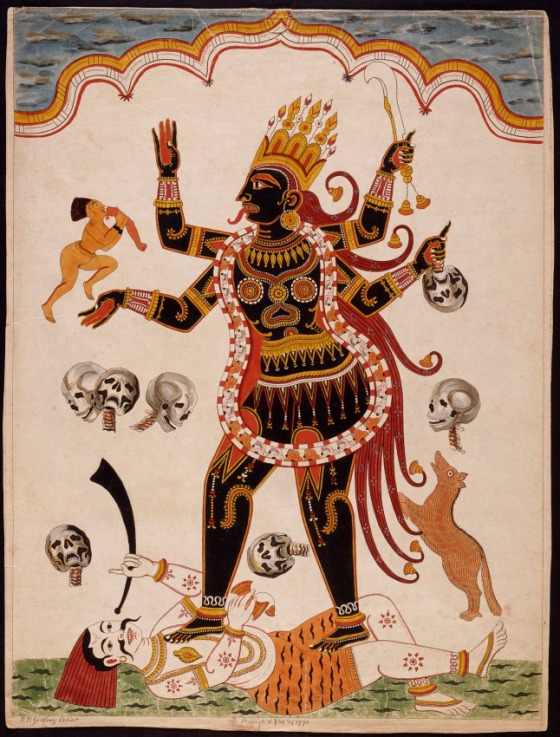
Quite fearsome, huh? (Photo courtesy of Wikimedia Commons)
Wanna know what's werid? I have a Kali in my world, too! And, indeed, my Kali is also "black as deepest night," has four appendages, and has a penchant for walking on, if not exactly dancing on, my chest:

Mental note - do not antagonize the girlfriend's cat. The world may not survive the repercussions!
State of Surreal (Finale?)
Finally, New York's long national nightmare is over. The deadlock in the state Senate, caused when two Democrats switched allegiances and caucused with Republicans just long enough to royally mess things up, has been resolved. How? In the only fashion really fitting the farce:
Pedro Espada Jr. returned to the Democrats and was named Senate majority leader on Thursday as part of a deal worked out by Senate Democratic leaders, ending a monthlong stalemate that has hobbled state government.Thus, what began with two Dem turncoats ends only after they both have a change of heart. Lots of sound and fury (told by idiots, to be sure) signifying nothing, in the end.
Mr. Espada’s return gave the Democrats 32 votes in the Senate, a clear two-vote margin that re-established their control of the chamber.
Leave it to Malcom Smith, the once and future Senate president, to deliver the ultimate punchline:
'At the end of the day, Democrats always come together,' he said.Ha!
More Proof There Is No God
No Creator in her right mind would allow this to happen:
A mere nine years after Tim Meadows smooth-talked his way to instant cinematic superstardom in 2000’s The Ladies Man, the SNL movie machine has roared back into action with the announcement of an upcoming cinematic vehicle for MacGruber, Will Forte’s mulleted parody of Richard Dean Anderson’s 80s TV action hero.For fuck's sake, it's a joke that was funny once! It wasn't even funny the second time they ran it during the same episode, not to mention the endless repetition that passes for talent on modern SNL. Oy vey.
Wednesday, July 08, 2009
Album of the Day
Three Sides Live, by Genesis (1982): Score one for truth in album titling, at least for a while. When this double LP hit stores in 1982, it delivered three sides of live tracks from the band's 1981 tour, focusing mostly on stuff from Duke and Abacab, plus the first appearance of an infamous "old medley." The four side was made up of studio left overs from those two albums, which had made their way onto B-sides or a UK EP called 3 x 3. That's what "the world" got.
The UK, already in possession of said studio leftovers, got a fourth live side, consisting of a clutch of classic older tunes, even with appearances from Steve Hackett and Bill Bruford. For whatever reason, when the album was remastered in 1994, Atlantic regularized things across the globe and the fourth live side was substituted for the studio stuff. All of which can lead to confusion - the poor person behind the counter at the Discount Den in Morgantown couldn't understand why I'd trade in one copy of Three Sides Live for another one without a lengthy explanation.
Oddly, although I never had much use for the studio stuff, I've come to like quite a bit of it as it's appeared in the Archives or the new boxed sets. "You Might Recall" and "Evidence of Autumn" are pretty good. I'll still never live long enough to erase the mental stain of "Paperlate," however (thanks, bro'!).
The Perils of Totalitarian Art
I've always been attracted to movies with interesting back stories. While Brazil is now one of my favorite flicks, I was initially attracted to it because of the titanic struggle that Terry Gilliam had to go through to get it released as he wanted it in the United States.
Along those same lines, I'd always wanted to see Alexander Nevsky, Sergei Eisenstein's tale of a 13th-century Russian hero's triumph over invading German crusaders. Finally, thanks to a well timed Borders coupon, I've been able to get my hands on the Criterion Collection version (which comes boxed with Eisenstein's two part Ivan the Terrible). If nothing else, it is a potent example of how a repressive dictatorship shapes art, in both overt and subtle ways.
Nevsky was the product of two brilliant artists in desperate need of a "hit," so to speak.
Eisenstein made his name as a pioneer of Russian silent film, most notably for The Battleship Potemkin. But by the time Nevsky was made in 1937, however, he was outside of the Soviet artistic power structure. A few years in Hollywood hadn't been fruitful. On return to the Soviet Union, Eisenstein had production on his film Bezhin Meadow (what's left of it is a bonus feature on the Criterion DVD) shut down by the government for being politically incorrect.
Eisenstein's collaborator was in similar straights. Composer Sergei Prokofiev had also gone abroad, though with more success. When he returned to the Soviet Union in 1935, he found himself working under the watchful eyes (and ears) of the "Composers' Union," which sought to limit outside influence in Soviet music. One of his works, Cantata for the Twentieth Anniversary of the October Revolution, was banned and went unheard until 1966.
With that background, you can see why Eisenstein was desperate. As this lengthy and funny review explains:
So when it came time to write his next screenplay, Eisenstein collaborated with Pyotr Pavlenko, a member of the secret police who allegedly sat in on NKVD interrogations. American filmmakers bitch and moan about dealing with Philistine studio executives, but at least those guys only pretend to be bloodthirsty madmen. To say Eisenstein was operating from a position of limited power is an understatement. It's not a surprise, then, that Alexander Nevsky is unsubtle and clumsy in its ideology. The real wonder is it wasn't titled Please Don't Kill Me, Comrade Stalin.Eisenstein chose Nevsky as a subject partly because so little was known about him and thus there was less chance of ideological straying. Eisenstein wound up making a film that's not just shot in black and white but is black and white in its storytelling: the honest (and oddly irreligious, for the 13th century) Russians, led by their humble superman of a leader (that would be Nevsky), defeat the invading very Catholic and nearly mustache twiddling German horde in a spectacular battle on a frozen lake. The script almost writes itself.
That background alone would be sufficient to make Alexander Nevsky a paradigmatic example of totalitarian art. But the regime impacted the film in a more subtle, and perhaps unintended, way.
Einstein and Prokofiev were truly collaborators on the project. According to another of the bonus features on the Criterion DVD, parts of the score were actually written first. Eisenstein would then take the music then shoot and cut the visuals to match. It was a technique inspired by, of all things, Disney's Silly Symphonies and, a project in the works while Eisenstein was in Hollywood, Fantasia. The result should have been a seamless marriage of visuals and music, something along the lines of what Stanley Kubrick would achieve decades later in 2001.
Instead, the regime trod all over the soundtrack in two critical ways. First, authorities required that Prokofiev record the score in a Soviet studio using Soviet equipment. Problem was, Soviet studio technology was about 15 years behind Hollywood's, which meant that the score wasn't very well recorded to begin with. Second, Stalin became so infatuated with the film that he rushed it into theaters before the soundtrack was polished. The speculation on the Criterion bonus feature is that the score we have now was meant as a "scratch" or demo track, which Prokofiev never had the chance to redo. Not surprisingly, the film is sometimes shown today with a live orchestra playing the score.
Audio quality problems aside, catching Stalin's favor must have been good for business, right? Oh it was, for a bit. The film opened in November 1938 to popular acclaim, before the tide of history swamped over it. On August 24, 1939, the Soviet Union signed a nonaggression pact with Nazi Germany. As I mentioned above, the movie is about a Russian army turning back invading Germans. That wasn't a politically astute story to tell once the nonaggression pact was signed, so the film was withdrawn from circulation.
If you know your history, you can probably figure out what happened next in the life of Alexander Nevsky. On June 22, 1941, the Nazis broke the nonaggression pact and invaded the Soviet Union. Hey, what a great time to push a film about brave Russians turning back German aggressors back into theaters! Ever since, the film has been part of the lore of Soviet cinema and remains the most popular (if not most acclaimed) work of Eisenstein's career. Prokofiev took the music for the film and repurposed it into the Alexander Nevsky Cantata, which remains a popular work today.
All that being said, how does Alexander Nevsky work as a flim? Honestly, it was a bit of a disappointment. Granted, it's more than 70 years old, but a lot of it comes across as stiff, sometimes bordering on corny (I agree with a lot of what's said in the review I quoted above). The good guys are really good and the bad guys are really really bad (they make the Borg or the Daleks look charming by comparison). That being said, it has some stunning visual sequences and the music is wonderful.
If you can lay your hands on a decent version, I highly recommend it. Not so much as brilliant cinema, but as a historical example of the kind of art that gets produced when the state tries to micromanage its artists. Sometimes, the better story is behind the camera, rather than what happens in front of it.
Open Mouth, Insert Foot
Holy cow, how did I miss this over the weekend. Formula One supremo Bernie Ecclestone - man whom nobody in the sport seems to have any affection for - said some really stupid shit in a newspaper interview:
In an interview with Britain's Times newspaper, Ecclestone was quoted as saying democracy 'hasn't done a lot of good for many countries.' And then added:That's not even the entirety of the stupid (ask him about women racers!), but that's the most concentrated. Really, Hitler was just a patsy along for the ride? Has Bernie never heard of Mein Kampf?
'Terrible to say this I suppose, but apart from the fact that Hitler got taken away and persuaded to do things that I have no idea whether he wanted to do or not, he was in the way that he could command a lot of people able to get things done.'
Don't get me wrong - when it comes to sports, a benevolent dictatorship is often the way to go. NASCAR is where it is today largely because Bill France ruled it with an iron fist for years, whereas American open-wheel racing is largely in the state it's in because there was no one person calling the shots. Of course, so often the dictator is not so much benevolent as befuddled (see Blatter, Sepp).
I suppose you could even make the argument that a truly benevolent king or emperor - someone who ruled absolutely, but justly and fairly - would be a better way to go than the messy workings of democracy. Two problems with that theory. First, it's awfully hard to suss out who is going to be benevolent and who isn't until they start impaling their enemies on the front lawn. Second, if you're going to make that argument, you need to find some more, well, benevolent examples than Hitler and Saddam Hussein!
I'm generally not a fan of punishing someone for giving light to their dumb ideas. But since nobody likes Bernie, anyway, can he just go away now?
Tuesday, July 07, 2009
Mister 3000
Not to toot my own horn or nothin', but that post below about Works is post number 3000 here at the Ranch. Hard to believe, it's been five and a half years since I got things rolling. Thanks to everybody who reads and/or comments!
Album of the Day
Works, Volume 1, by Emerson, Lake, & Palmer (1977):Kids, back in the old days – before the Internet and iPods and flying cars (er, wait a minute . . .) – music used to come on things called “albums.” “LPs” to be precise, which stood for “long playing.” They were big black (usually) discs with a groove on each side, from which the stereo fairies harvested recorded sounds. Since a person had to get up and turn a LP over midway through, each side was kind of thought of as a separate unit.
I say all that as background, ‘cause otherwise you won’t understand the operative theory behind this album. See, as a double LP, it had four sides. Thus, the guys in the band decided to each have a side for themselves, before returning to ELP in all its glory on side four. Emerson takes side one and fully gives in to his classical pretensions, producing a piano concerto. It’s not a masterwork, but it’s got its moments (as was highlighted by a kick ass drum corps adaption by Blue Devils, IIRC). Side two belongs to Lake, who poots forth an entire side worth of acoustic ballads. You can’t be too hard on Lake’s stuff – “Lucky Man” and the like are as much a part of ELP’s legacy as “Tarkus” or “Karn Evil 9” – but an entire slab of it at once is a little too much. Palmer takes up side three, with an interesting collection of instrumental stuff, on which he gets help from Joe Walsh, of all people. But the highlights of the album come on side four, where the band reunites for an extended workout of “Fanfare for the Common Man” and the epic seafaring tale “Pirates”. Honestly, post 1974, that’s the best the boys would manage.
In the wake of such indulgence, there was only one thing to do: load the whole kit and caboodle up on a series of semis – the band, the orchestra, Emerson’s massive Yamaha GX-1 synth, Lake’s infamous carpet, Palmer’s equally infamous (to the road crew, anyway) stainless steel drum kit – and tour the world. It was, in a real sense, a twilight of the prog rock gods (Godderwankerung?).
On Being a Gracious Winner
I have a theory about the American criminal justice system. Though not quite fully formed, it goes something like this: The adversarial nature of the American system turns the trial process into a contest between two sides, which invariably produces a winner and a loser. Often times, it seems that various players in the systems - defendants, victims, lawyers on both sides - are more concerned with winning than whether "justice," however that is defined, is done. As a result, folks who perceive that they've lost the "game" don't accede very well to the results, even if they really shouldn't complain.
So, let's say, you're playing in a pick up soccer game. You don't like the guys on the other team and when you finally win, you indulge in some exceptionally gratifying smack talk. What's the worst that could happen? I suppose you could get punched, but probably the losers will just walk away.
A word to criminal defendants everywhere - prosecutors don't like to lose and they generally are not willing to walk away. Witness this case from Virginia (via Doug Berman):
Powell, 31, was convicted in 2000 of killing Reed and raping and trying to kill her 14-year-old relative. He was sentenced to die for Reed's murder.Now, there are serious double jeopardy issues here and it will be interesting to see what, if anything, the Supreme Court does with the case. But the meta lesson shouldn't be confined to legal principles: when you win, do so with grace and humility. If you act like a douche bag, don't be surprised if you get squeezed.
The Virginia Supreme Court overturned Powell's capital conviction, saying that Prince William County prosecutors failed to prove Powell tried to rob or rape Reed. In order to face capital punishment, defendants must commit other crimes against the victim or meet other aggravating circumstances.
Thinking he could no longer face the death penalty, Powell wrote a profanity-laced, taunting letter to prosecutors offering graphic detail of how he tried to rape Reed before he stabbed her three times and stomped on her throat until she quit breathing.
'Do you just hate yourself for being so stupid and for (messing) up and saving me?' he wrote to Commonwealth's Attorney Paul Ebert in 2001.
Ebert threw out Powell's earlier indictment and charged him with killing and attempting to rape Reed. Powell was convicted again in 2003 and given the death penalty.
Way to Go Gooch!
Well, it looks like last month's performance by the United States in the Confederations Cup is starting to pay dividends for individual players. Mammoth defender Oguchi Onyewu, who for years has been rumored to be leaving Standard Liege in Belgium for bigger stages, is headed for the big time:
AC Milan have quickly wrapped up a deal for United States centre back Oguchi Onyewu on Tuesday in a bid to quell supporter unrest over their transfer policy.If I'm remembering correctly, Gooch will be just the second American to play in Italy's top league (Alexi Lalas did it for small fry Padova way back when). Regardless, he will also be the first American to (hopefully) be a regular in the starting 11 for one of the world's biggest clubs.
The 27-year-old, who impressed in the U.S. side's run to the Confederations Cup final last month, has joined on a free transfer from Standard Liege and penned a three-year contract.
Hey, I've got a rooting interest in Serie A now - Forza Gooch!
Monday, July 06, 2009
Album of the Day
Dancing, by Mike Keneally and Beer for Dolphins (2000): I should listen to this album more often. It rocks me. It grooves me. It makes me sing, loudly and out of tune. It makes me look like a dipshit, walking around my office in an air guitar frenzy. In short, it makes me smile. The sort of big goofy grin kind of smile that nobody ever really experiences enough in life. Yup, I should listen to this album more often.
Is This Really a Pressing Issue?
I'm currently reading (well, listening to) Jonathan Strange & Mr. Norrell, the 2005 Hugo winner by Susanna Clarke. It's about two magicians in early 19th-century England who aspire to return English magic to its rightful place in the world, and defeat Napoleon in the bargain. I'm not far enough into it to know how it turns out, but it's very cool so far. It's written in the style of a learned treatise on the two men (written by whom, I don't yet know), complete with footnotes explaining various terms, providing dates of the relevant people involved, and, in the spirit of a good law review, providing citations to various books on magic and magicians.
As you might imagine, part of the back story involves fairies and the interaction between them and humans. I'm afraid the verisimilitude of the novel has taken in some particularly susceptible folks (via PZ):
About 250 people came to the Methow Valley June 26 through 28 from as far away as Europe and Hawaii to participate in the ninth annual Fairy and Human Relations Congress, an outdoor festival in a secluded mountain meadow called Skalitude.Although I'm not quite halfway through the book, I wonder if alliances with the fairy realm is really that good of an idea? I mean, far be it for be to disagree with Skeeter, but if someone called The Raven King shows up, we're in deep fairy shit.* * *
'The purpose of the congress is to encourage communication and cooperation of the fairy realm,' said Michael 'Skeeter' Pilarski, the event's founder and organizer.
The human world is in crisis and can use all the help it can get, Pilarski said, so why not form alliances with those in other realms?
Ah, but Skeeter does stumble into a bit of truth, completely by accident:
Skeptics might mock the participants or dismiss them as New Age hippies, but they say their belief system is not much different from Native American animists or even Christians who believe in angels.You're right, Skeeter - they're not so different from angels and the like in that they're equally products of you imagination. Talk about damning with faint praise.
'We might call (fairies) angels of nature,' said Pilarski, an herb farmer and writer who also founded the annual Okanogan Family Barter Faire in nearby Tonasket.
Moroccan Metal
Next time you think your band is having problems, consider the plight of heavy metal bands in Morocco. As one musician's father explains:
'If it's just to express a freedom, OK.It's sort of nice that moms are the same in every culture, tho - the mother of the subject of the piece isn't really a fan of her son's music, but she still plays it for friends and visitors!
'But as Muslims, as Moroccans, as an Arabic society, we have certain limits.'
Those limits were apparently breached in 2003 when 14 heavy metal fans were accused of Satanism, and imprisoned.
Human rights groups and performers took to the streets, saying the rockers were guilty only of wearing black clothes and singing provocative songs.
Shortly afterwards the 14 were released.
Friday, July 03, 2009
The Douglas Chronicles: Dye Another Day
As I've explained before, MamaK and Roy's raise critters on their ranch for their hair of fur, which then becomes wool. As fate would have it, K is a knitter and otherwise consumer of said fiber products. Nice synergy, huh? Of course, such talents run in the family, so MamaK does her share of fiber stuff, too.
One part of that craft is dyeing wool, either in "raw" form or after it's been spun and refined, to create a more distinctive look. With oodles of fiber on hand (both on the hoof and off), K, MamaK, and I spent an afternoon dyeing some bits. It was, as you might expect, my first chance to try my hands at it.
First, of course, all the accouterments must be assembled:
Our dyeing involved two different types of wool. The first batch consisted of raw unrefined wool. It hadn't yet been spun into yarn or something equally useful. In fact, it had already been dyed once, which produced a black to grey streaked bunch. We'd be dyeing it again (overdyeing, I believe it's called) - purple this time - with the new color taking on the shading of the original. Here, K soaks the wool:
And then it gets dumped in a pot of warm water that's had the dye infused into it:
More like cooking than crafting, really. The results were pretty cool:
The second batch of dyeing involved wool that had already been spun into yarn. However, it was in one loooong hunk of stuff, and needed to be wound out into individual skeins, which would they be dyed. Turns out, I was pretty good at it:
The actual dyeing, not so much. Having never worked with wool before, I didn't have any real idea of how it would react to color and liquid. I ended up with the dry skein (they can be either dry or wet when dyed), over which the dye tended to run, before soaking in the back. Needless to say, whatever grand plan I had going into the process didn't play out in the end. I think it still turned out pretty well, but didn't get any pictures (sorry).
K, on the other hand, knew just what she was doing. She whipped out two skeins in the time it took me to finish one. Then she set upon a third skein, made with stylistic input from the both of us. In other words, she did the work, I said "that'll look pretty" and took pictures:
The finished product, before drying: The things we dyed sat out overnight to dry. The next day, K and MamaK worked out some of the kinks:
And the lovely K models two of her finished products:
As does you humble narrator: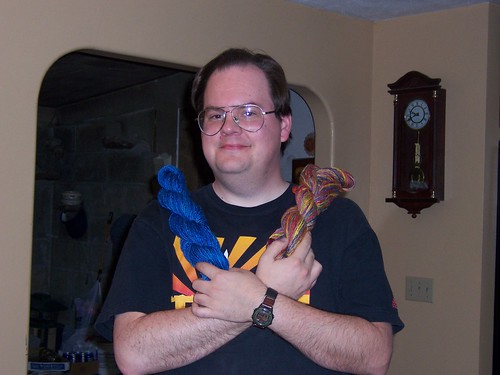
That's my experience being crafty.
And there you have it, dear reader(s), a chronicle of my adventures in Big Sky country. It's a beautiful and breathtaking place, in its own way, and full of friendly people. But I was glad to get back to my green mountains and big (relatively!) city.
Thursday, July 02, 2009
The Douglas Chronicles: The Sights
Let's be honest, Doulgas, Wyoming is not exactly a major urban center. Nevertheless, it is the commercial and legal hub of Converse County and is the only thing vaguely resembling civilization in the area. As such, it's got its own unique and interesting history to learn and sights to see.
The afternoon after K and I arrived, we took the grand tour. Both MamaK and Roy have lived in and around Douglas for years and know all its nooks and crannies. Unfortunately, neither K nor I had our camera for that adventure, so you'll have to close your eyes and imagine.
But if you're at all familiar with West Virginia, here's a way to get your imaginings started. Douglass is a town of about 5000 people. It is also perfectly flat. Imagine a small West Virginia town, say, Grafton, had a giant hand pressed down upon it from above, completely flattening it out. It's no bigger than it once was, it just seems that way because all the mountains are gone. As a result, Douglas has amazingly broad boulevards for such a small towns. That made quite an impression on a guy whose dodged more than a small number of coal trucks on twisty two lanes getting in or out of said hillbound hamlets.
Douglas was born as a railroad town in 1886. At the time, it was the terminus of the Union Pacific. It still a railroad town, to a certain extent, but its importance to the area has diminished over the years. It's also the long time home of the Wyoming State Fair. Finally, it's the home to this disreputable critter:
The jackalope is a legendary creature that's a mix of jack rabbit and antelope. It probably stems from some sort of funky disease that the rabbits get every now and then, but that's not very entertaining. It certainly wasn't for the state of Wyoming, which designated Douglas the Home of the Jackalope in 1985.
Okay, I shouldn't have said "finally," because Douglas is also home to the Wyoming Pioneer Memorial Museum. Although the name suggests that it focuses only on the frontier days around the city's founding, it actually covers time periods up to the Second World War. It's focused on Douglas, of course, and has some really interesting collections. Here is your humble narrator, posing beside the original printing press from the weekly paper, the Douglas Budget: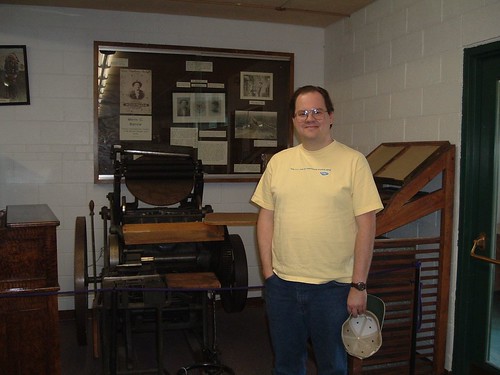
There's so much stuff packed into the museum, in fact (it also houses the Wyoming Pioneer Association archives), that it could use a reorganization/makeover comparable to what the West Virginia State Museum just wen through.
Although Douglas was founded in 1886, white settlement in the area predated that period. In 1867, the federal government built Fort Fetterman, about 10 miles outside of what would become Douglas, alongside the Bozeman Trail. It would be come a major jumping off point for several of the wars with the Native Americans, including the Black Hills War, which included the Battle of Little Bighorn (aka Custer's Last Stand). The fort was abandoned in 1882, leaving behind a civilian outpost dubbed Fetterman City. Fetterman City died a slow death once Douglas was founded.
Today, Fort Fetterman is a state historic site. All that remains is an officer's quarters (right) and ordinance warehouse (left), both given over to exhibits:
However, the rest of the fort's lands are part of the history sight, with identification and informational signs that guide you around what was once a parade ground and up on the high bluff from which that picture was taken. From there, you can look over the North Platte River, and the spot beside it where the saloons, whore houses, and the like sprung up.
While the rest of the group was checking out the indoor exhibits, I wandered around the parade ground up on the bluff. Luckily, I wasn't alone, as I had Sid, the site's resident border collie, with me: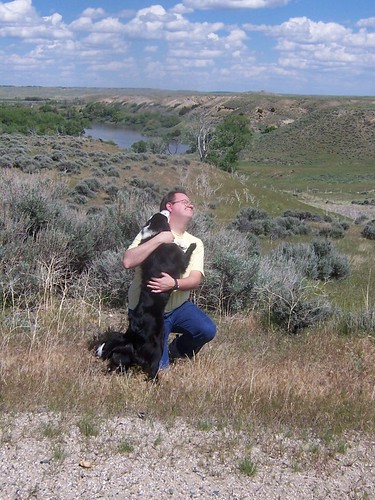
After Fort Fetterman, we headed off to see one of the area's natural attractions, Ayers Natural Bridge. About 15 miles from Douglas, it's a column of solid rock that arches out over a babbling brook. Here I am on the "front" side of the bridge:
There's a very steep, narrow, rocky trail that leads up to the top of the bridge. The view is worth the short hike, but the route back down is pretty tricky. Needless to say, I'm proud of myself for making it back to ground level in one piece. Here's K on top of the bridge:
Here's another shot from the top of the bridge, down the valley of the stream. The building on the left is what's left of a power station that was built early in the last century.
Here's a picture of the back side of the bridge (thankfully, there's an easy walk around, although you can trek down the steep path on both sides):
On the under side of this part of the bridge, dozens of birds (I can't remember what kinds) were using the nooks and crannies as places to build nests:
They were collecting mud from a small pool on the other side of the stream.
Speaking of the stream, take a close look at this picture. What do you see?
Looks sort of like a horse's head, sticking out of the raging rapids as the horse struggles valiantly to stay above the surface. Actually, it's just a cool looking stick. Neat, huh?
Ayers Natural Bridge has a whole host of park apparati to while away the time. That includes swings, of course. If K sees swings, she must partake (state law). I, of course, couldn't refuse the invitation to join her:
That was our day in and around the sights of Douglas. Tomorrow - I am forced to be crafty!
Album of the Day
Yesshows, by Yes (1980): Ah, we've hit a milestone in the annual A-Z trek - the first multi-disc album. Sure, there are several single disc albums that are longer, but still, it's worth noting. This is the band's second live set and it appropriately enough focuses on tracks from albums released after Yessongs (save "Time and a Word"). Although it was mostly recorded on the tour(s?) between Tormato and Drama, the two epics are taken from the Relayer tour, and thus feature Pat Moraz on keyboards instead of Rick Wakeman. Not as comprehensive or brilliant as its predecessor, for some folks this was the cap on the definitive Yes era.
Who Owns Holden Caulfield? (Redux)
Last month I blogged about the legal battle between JD Salinger and the publisher of a book called 60 Years Later: Coming Through the Rye, by Fredrik Colting. Salinger claims that the book is an unauthorized sequel to The Catcher in the Rye, while Colting calls it a literary critique or "metafiction" dressed up like fiction. A federal judge had issued a temporary order prohibiting the book from being published in the United States (it's already out in the UK).
This week, the judge made the order permanent, rejecting Colting's claims:
To the extent Defendants contend that 60 Years and the character of Mr. C direct parodic comment or criticism at Catcher or Holden Caulfield, as opposed to Salinger himself, the Court finds such contentions to be post-hoc rationalizations employed through vague generalizations about the alleged naivety of the original, rather than reasonably perceivable parody.So, contrary to popular belief, you can ban a book in this country. You just need good IP lawyers.
How Much?!?
In most states (or in West Virginia, at any rate) passing the bar exam does not guarantee you a ticket to practice law. Your "character" has to be signed off upon, which comes after an interview with a few bar members. In my chase, the interview took about five minutes and didn't give any cause for alarm.
I was a little surprised, however, when they asked about student loans. Did I have them? Yes, of course. I managed to make it out of undergrad without debt (thank you very much, Mom and Dad!), but even with a scholarship I rolled out of law school with a five-figure debt load. I knew it wasn't that much, comparatively, but I'm still paying it off even now.
So consider the story of Robert Bowman, who overcame a bunch of physical setbacks to get a law degree and pass the bar in New York. But the state bar won't sign off on his character:
But a group of five state appellate judges decided this spring that his student loans were too big and his efforts to repay them too meager for him to be a lawyer.You read that right. The precise number is actually more like $435,000, and climbing.
'Applicant has not made any substantial payments on the loans,' the judges wrote in a terse decision and an unusual rejection of the committee’s recommendation. 'Applicant has not presently established the character and general fitness requisite for an attorney and counselor-at-law.'
Mr. Bowman, 47, appears to have crossed some unspoken line with his $400,000 in student debt and penalties, accumulated over many years.
Putting aside Bowman's arguments that part of the large load is due to lender malfeasance, it seems to me that he's caught in a financial catch-22. One the one hand, he incurred this load of debt no doubt on the theory that his legal career would allow him to make the kind of money he'd need to pay it back. On the other hand, the New York bar now won't let him enter the practice - because he racked up too much debt on the way to them. There was certainly no guarantee he would graduate with a JD or pass the bar when he took out the loans, but surely he didn't consider that the fact of the loans themselves would be the problem. It seems perverse.
Having said that, I can see where the bar is coming from. One of the (many) benefits of my job is that we don't deal with client money. Nobody pays fees and we don't handle lawsuit proceeds or anything like that. From what I've seen in the past ten years, a great deal of bar disciplinary proceedings involve lawyers who have been lax, or worse, with client money. I suppose you could argue that someone with an excessive amount of debt would have a strong motive to skim some extra off the top.
I don't see that as a good reason to keep him out of the profession, though. Maybe under a close watch, but that should be sufficient.
Yes, Stephen, It Is!
| The Colbert Report | Mon - Thurs 11:30pm / 10:30c | |||
| Is it Time to Care About Soccer? | ||||
| ||||
| The Colbert Report | Mon - Thurs 11:30pm / 10:30c | |||
| Is it Time to Care About Soccer? | ||||
| ||||
Wednesday, July 01, 2009
The Douglas Chronicles: The Critters
The ranch is filled with numerous critters of various description and roles. You don't even have to leave the house to start meeting the crew, as MamaK and Roy have three cats that live in the house. Of those, I quickly became friends with this large fellow:
Where most cats are standoffish and suspicious, this one wanted nothing more to jump up on your lap and get some attention, even if he'd never seen you before in his life. Due to his disposition and chunky proportions, I dubbed him Chubby Huggs. Despite his girth and genial disposition, Chubby Huggs is the resident mouse catcher and is quite good at it (we saw him track one down).
Outside the house there are several critters that have the run of the yard. One group consists of the seven border collies that keep the farm critters in line (sort of). They're all a friendly bunch, and likely to nearly knock you over when you try to come out the front door. Especially if you have a treat in your hand:
That's the matriarch of the collie crew (whose name escapes me right now), licking her lips.
There's another working dog on the ranch, in addition to the collies, Abbie:
Abbie is an Akbash, a large (and I do mean large) Turkish dog that's been bred to be the guard dog of a flock of critters. In spite of her job description and fearsome demeanor if you're, perhaps, an interloping coyote, with her people she's an absolute sweetheart. Did I mention she was big? She nearly knocked me over with her enthusiasm one morning. For a sense of scale, compare her to your humble narrator: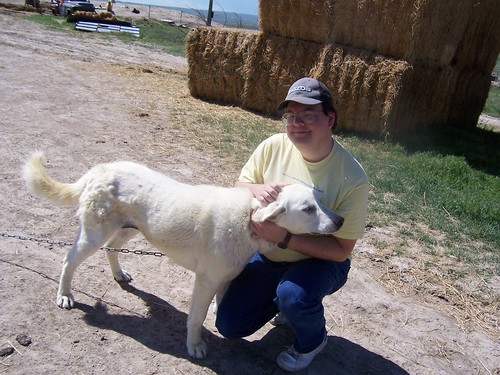
In addition to the dogs, there are some "non traditional" (to a city boy, at least) critters who roam the yard. Specifically, a pair of babies, being weened from bottle feeding. A goat, named Sierra, and a black sheep, named Spring (she was born on the first day of spring). One morning, K got a chance to feed 'em:
And, of course, the next morning, it was my turn: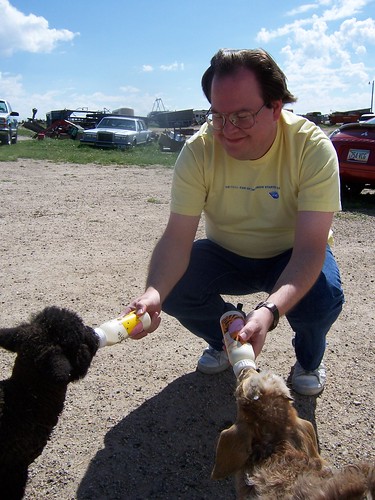
Here's a better shot of Spring.
I'm particularly proud of that shot, as I managed to get it without injuring myself. Spring was following me around one morning, but wouldn't settle down long enough to have her picture taken. "Aha," I thought to myself, "I'll walk backwards while she follows me. That will work!" Assuming, of course, I don't trip over myself, fall over, and break something vital. Thankfully, I lived to tell the tale and Spring cooperated nicely.
Of course, Sierra should get her close up, too:
I have to say, by the end of the week, they'd really taken a shine to us: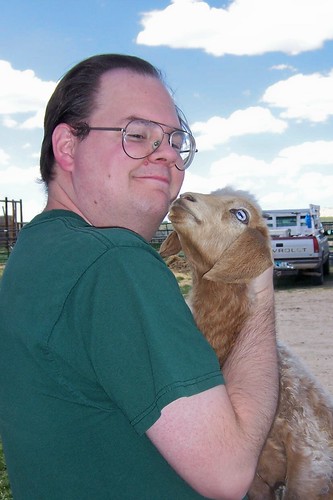

Along with the baby critters, another of the goats had free reign around the yard, Persia. Here she is, surveying her domain:
On the other side of the fence is where the more usual "farm" critters could be found. As I said, MamaK and Roy generally are raising these creatures for their wool, to turn into yarn and such. But there are a couple of more typical bits of livestock about. Hey, look, cows:
Well, sort of. The big fluffy horned thing in front there is a Yak. More of them later.
In addition to the critters out roaming the range, there are some who are confined to their pens and have their humans come and feed them on a daily basis. Such as a mama goat, popping up for her photo op:
And a couple of sheep, hanging out in the morning sun. As you can see, they're past due to be sheared (no pictures of that, however. Or of me doing it!):
About mid week, MamaK and Roy operated as go betweens for the sale of some baby sheep. One of MamaK's coworkers wanted some for her children (that's what kids get in Wyoming ranch country!). The whole parcel of little ones therefore took up residence for about a day in a little pen beside the house.
They were many:
And they were vocal:
As noted above, there are yaks on the ranch. Yaks produce an awful lot of wool and, when it comes to making more yaks, are much more long term producers than, say, cows. They are large critters, and it's a bit unsettling to have one wander around in your general vicinity. If you're me, that is.
However, when there's a nice fence between the two of you, a yak can just be a big ham:
Up tomorrow - the sights of Douglas!
Album of the Day
Early Plague Years, by Thinking Plague (2000): This is a compilation of the American avant-proggers' first two LPs, . . . a Thinking Plague and Moonsongs, each slightly trimmed to fit on one CD. Over the course of these tunes, the band sails surely from ambient waves of sound ("Collarless Fog that one day soon"), intricate start/stop prog ("Warheads"), and the just plain weird ("How to Clean Squid," with lyrics taken from a cooking magazine!). I find some of it is just too out there for my tastes (weird for weirdnesses sake), but when it hits the sweet spot, it's great stuff. The album closer, "Thorns of Blue and Red / the War," also has one of the more interesting stories behind it. The lyrics are taken from the poems found in a book in a dumpster behind a hospice, presumably written by a recently deceased woman.
Subscribe to:
Posts (Atom)